
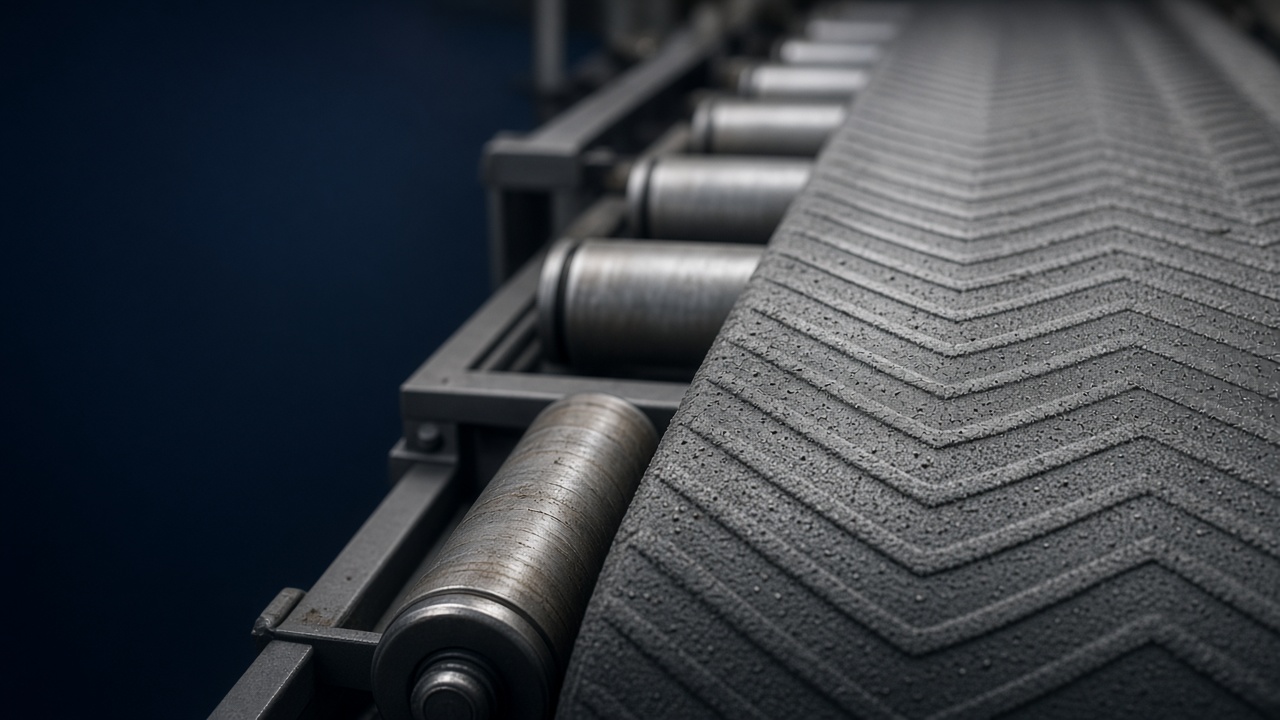
Belt cleaners are the carryback system on a conveyor: primary and secondary units working with ploughs, tensioners and a tip-replacement programme. This page is about that cleaning strategy and how it interacts with chutes and skirts — not about individual blade shapes in isolation.
Part of the Conveyor Knowledge Centre. Research the duty first, then request a quote when you are ready to brief suppliers.
Carryback is material that sticks to the belt past the discharge pulley and drops along the return run. A cleaning system usually places a primary cleaner against the drive pulley, a secondary cleaner on the flat belt after the pulley, and plough devices where stubborn fines or tramp would otherwise reach the tail pulley. Polyurethane and carbide tips are the usual wear materials depending on abrasion and belt cover type; the system only works if tip pressure, mounting rigidity and a tensioning habit are specified together.
Cleaners are not a substitute for good chute sealing and skirt systems, but they are essential on wet coal, clayey ores and sticky concentrates common on South African plants. Fasteners on the belt can limit which blade systems are safe to use. Stainless or coated hardware lasts longer in corrosive wash-down areas. Note belt width, belt speed, material type, pulley diameter and whether the belt has mechanical fasteners when requesting quotes.
A cleaner programme includes inspection intervals, re-tensioning and a spare-tip store — a frame without a tip plan becomes a piece of abandoned steel under the head chute. Blade-level geometry and plough profiles are covered on the scrapers page; here the question is how primary, secondary and plough positions work as one carryback strategy with the chute mouth and skirt line.
Common applications
Cleaning systems are fitted on new conveyors as standard practice, retrofitted where spillage under the return belt has become a housekeeping and safety problem, and upgraded when tip life is too short for the duty. Plants with long galleries gain the most: less shovelling, fewer idler seizures from fines build-up, and cleaner walkways for inspections.
- Primary and secondary as a pair — The first cut of coarse carryback at the head pulley, then fines removal on the leaving belt. Specifying only one station on sticky coal or chrome ore often leaves a dirty return run.
- Ploughs in the return path — Protect tail pulleys from material trapped on the return belt. They are part of the cleaning strategy, not an optional extra after lagging is already damaged.
- Reversible belt systems — Dual cleaner arrangements and careful station layout so the system still controls carryback when the belt runs the other way.
- Head-chute constrained retrofits — Some chutes leave little room for a robust primary. Suppliers need that constraint early so the strategy can shift emphasis to secondary cleaning and chute or skirt work.
Industries that use this equipment
Coal handling, platinum and chrome processing, iron ore, aggregate washing plants and cement raw mills are heavy cleaner users because product sticks or abrades. Sugar, grain and fertiliser plants care about cleanliness and dust. Ports need systems that cope with wet bulk cargoes and limited maintenance windows between vessels.
Underground conveyors need compact, serviceable designs that crews can tension safely. Surface overland belts prioritise tip life and a programme that can be inspected from the gallery. Matching supplier experience to sticky versus abrasive duty avoids fitting a soft tip where carbide is justified, or the reverse. Plants that already standardise on a cleaner family should say so — tip compatibility often matters more than swapping the entire mainframe during a short shutdown.
Specifications buyers should consider
The list below is a briefing checklist, not a datasheet. Exact ratings, dimensions and standards must come from the duty, existing plant records and the supplier quotation — do not treat generic web copy as a specification.
- Cleaning strategy: primary at the head pulley, secondary on the leaving belt, and ploughs where the return path needs protection — quoted as a system, not a single frame.
- Belt width, speed and pulley diameter, plus whether the belt is reversible.
- Tip family: polyurethane versus carbide, chosen against abrasion, cover type and mechanical fasteners.
- Tensioning method and whether it can be maintained safely from the available access.
- Mounting space in the head chute and rigidity of the steel that will carry the mainframes.
- Compatibility with skirts and chute sealing so cleaning is not asked to hide a flooding load point.
- Hardware material for corrosion — wash-down, wet coal and coastal air seize painted mild-steel springs.
- Tip-replacement programme: cartridge type, local spare holding, and inspection interval as a briefing item.
Factors that affect selection
- Carryback control is a system: cleaners, chute geometry and skirt sealing fail or succeed together.
- Mechanical fasteners may rule out some carbide arrangements that would otherwise suit abrasive ore.
- Access to tension and change tips decides whether the system will actually be maintained after commissioning.
- Sticky coal, platinum, chrome and iron-ore duties need different tip and station combinations than dry aggregate.
- Standardising tip families across a plant simplifies stores; changing frames on every conveyor does not.
- Reversible belts need a layout that still cleans in both directions rather than a one-way primary copied from another line.
Common problems and failure considerations
- A single primary with no secondary on sticky product, leaving fines to bury return idlers along the gallery.
- Frames mounted on thin chute walls that chatter, so the system looks like a “blade problem” when the structure is the issue.
- Tips left un-tensioned until they skip; carryback then seizes returns and damages belt edges.
- Carbide on a mechanically fastened belt, or a soft tip on highly abrasive ore — both waste the programme.
- Cleaners specified while skirts leak and the chute floods, so the belt is dirty before it reaches the head.
- Painted hardware in wet coal or wash-down service that seizes, after which nobody adjusts the system.
Maintenance considerations
- Re-tension on a planned interval; cleaner systems drift as tips wear and as product moisture changes through the season.
- Keep spare tips on site for the family you standardised — frame design matters less than being able to renew the working edge.
- Inspect ploughs on the return run when tail-pulley lagging starts to suffer; that is a system failure, not only a pulley issue.
- Do not over-tension to hide a chute that loads wet fines into the cover; fix skirts and loading with the cleaner programme.
- Photograph head-chute space and current mounts before a shutdown so replacement stations fit the same steel.
- Train crews that a cleaner left touching nothing is as useless as one set so hard it grooves the belt.
Questions buyers should ask suppliers
- Are you quoting a carryback system (primary, secondary, ploughs) or a single station?
- How does your tensioning method get maintained from our access, and what tip programme do you assume?
- Is the proposed tip compatible with our cover and with mechanical fasteners if we have them?
- Have you allowed for head-chute space and mounting rigidity, or will brackets be a variation?
- How should this system work with our skirts and chute sealing rather than against them?
- What hardware finish are you offering for wet coal, wash-down or coastal corrosion?
What to include when requesting a quote
Clear briefs produce comparable quotations. Include what you know, and mark estimates separately from measured values. Photos and drawings help more than extra adjectives.
- Belt width, speed, pulley diameter and whether the belt reverses.
- Material — coal, platinum, chrome, iron ore or other — and whether it is wet or sticky.
- Presence of mechanical fasteners or vulcanised splices only.
- Photos of head-chute space, current mounts and the return path ahead of the tail pulley.
- Whether primary, secondary and ploughs should be quoted as one system.
- Skirt and chute condition if spillage starts at the load point as well as at discharge.
- Preferred tip family if the plant already holds spares, plus corrosion environment.
- Access and shutdown window for installation and the first tensioning check after restart.
Related conveyor information
Related components: scrapers, skirt rubber, chutes, pulleys, belting.
Guides: Industrial Conveyor Maintenance Guide, Belt Tracking and Splice Basics.
Resources: Conveyor maintenance guide, How to request a quote.
Frequently asked questions
How is a belt-cleaner system different from a scraper blade?
This page treats cleaning as a strategy: primary and secondary stations, ploughs, tensioning and a tip programme, working with chutes and skirts. Scraper hardware — blade and tip shapes, plough geometry — is a related but narrower topic. A well-chosen tip still fails if it is the only station on a sticky belt or if the chute floods the cover.
Do we always need primary and secondary cleaners?
Sticky or wet bulk — coal, many platinum and chrome streams, iron ore in rain — usually needs more than a single cut at the pulley. Dry, free-flowing aggregate may be managed with a simpler arrangement. Describe the product and show the return run; suppliers can then argue for one station or a full system against the same evidence.
Why do mechanical fasteners change the cleaner quote?
Some tip systems are unsafe or short-lived on fastened belts. Fasteners can limit carbide options and increase the chance of tip or cover damage. State fastener type in the brief so the cleaning strategy is legal for the belt you actually run.
Can better cleaners fix a leaking skirt line?
They cannot. Load-point leakage puts material into the cover before discharge. Cleaners then work harder, bury more readily, and still leave a dirty gallery. Quote cleaners with skirt rubber and chute work when the spillage problem starts at loading as well as at the head.