
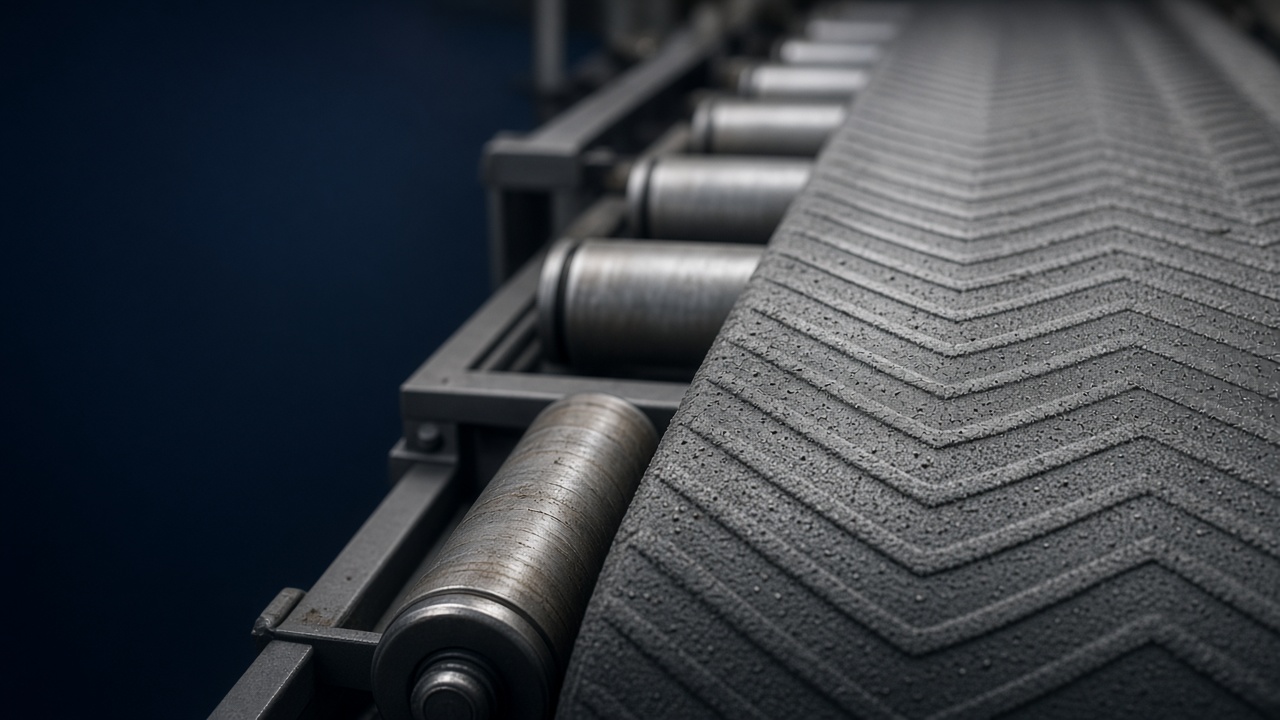
Conveyor rubber products are the sheets, liners, lagging and wear parts that protect steel and restore friction around bulk handling equipment. On South African mines, quarries and process plants they are usually bought as a family of stores items rather than as a single moulded component. This page covers that family. Loading-point sealing strips — the rubber that closes the gap between skirt boards and the moving belt — have their own page, because the duty, clamp hardware and adjustment habit are different from chute liners or pulley lagging.
Part of the Conveyor Knowledge Centre. Research the duty first, then request a quote when you are ready to brief suppliers.
The family typically includes pulley lagging sheet and strip, chute and bin liners, impact and wear rubber, wear flaps, and miscellaneous sealing pads used on transfer-house doors, enclosure panels and vibration isolation. Compounds are chosen for abrasion, hardness, oil resistance, heat and, where relevant, flame performance. Thickness, fabric insertion and the fixing method — chemical bond, bolt-through, clamp or a combination — belong in the specification alongside cut sizes.
Rubber selection should match the material handled. Sharp quartzite and iron ore gouge soft liners quickly. Sticky clay and wet coal want a different surface behaviour than dry crushed aggregate. Oily products around coal preparation or packaging swell unsuitable compounds. General-purpose abrasion sheet is not a universal spare: heat, oil or underground fire performance each narrows the grade.
Many plants keep a standing order or a short list of standard sheets so shutdown crews are not waiting on a converter while a chute hole grows. Custom-cut kits for repeated chute geometries save marking time on dusty scaffolds. Bonded lagging work is often coordinated with pulley change-outs and may travel with a vulcanising crew even though the material itself sits in this rubber-products category.
Skirt rubber at the loading point is part of the same stores family in some catalogues, but it is specified as a sealing strip with holders, not as a liner plate. If your enquiry is only about containing fines at the chute mouth, use the Skirt Rubber page and tick that intent clearly. If you are refreshing lagging, liners and impact bars together, stay on this page and list each duty in the notes.
Common applications
Plants order conveyor rubber when liners hole through, drive pulleys start to slip, impact zones beat the belt cover, or a stores catalogue is being standardised across shafts. Typical duties include:
- Pulley lagging sheet and strip — Restore friction on drive pulleys and protect shells on tail, bend and take-up drums. Ceramic-insert lagging is a related option on wet or high-tension drives; say if you want rubber-only sheet or a ceramic system so quotes are comparable.
- Chute, launder and bin liners — Sacrifice rubber instead of structural plate in abrasive streams. Thickness, insertion and whether the liner is bonded or mechanically fixed change both life and how crews replace it during a short stop.
- Impact and wear rubber — Protect loading-point steel, impact beds and structure where lump ore or crusher discharge hits. This is wear protection, not the adjustable skirt seal that rides on the belt cover.
- Sealing pads, flaps and isolation — Dust doors, enclosure panels, wear flaps and vibration pads around equipment. Dimensions and Shore hardness matter more than a generic “rubber sheet” description.
Industries that use this equipment
Mining and mineral processing — platinum, chrome, iron ore, manganese, coal and mineral sands — consume the most industrial rubber for liners and lagging on abrasive, high-tonnage transfers.
Quarries, aggregate wash plants and cement raw mills run frequent liner change-outs on short, steep conveyors and crusher discharge chutes.
Ports and ship loaders replace liners and lagging on aggressive schedules during cargo peaks; coastal humidity and UV also affect how spare rubber is stored on site.
Sugar, grain and fertiliser plants still use conveyor rubber, but some areas need contamination-aware or food-appropriate grades — state that exposure rather than assuming mine-grade sheet.
Specifications buyers should consider
The list below is a briefing checklist, not a datasheet. Exact ratings, dimensions and standards must come from the duty, existing plant records and the supplier quotation — do not treat generic web copy as a specification.
- Duty of each item: lagging, chute liner, impact pad, wear flap or mixed kit — do not lump them as “rubber” without saying where it sits.
- Material handled: ore type, coal, aggregate, sticky clay, oily product, heat or flame exposure.
- Sheet or moulded dimensions, thickness, and whether fabric insertion is required.
- Preferred hardness (Shore A) if you already have a working grade, or a sample reference from stores.
- Fixing method: bond (and adhesive system), bolt-through, clamp, or ceramic-insert lagging.
- Surface to be protected: pulley shell, chute plate, impact frame or enclosure — including whether steel is already worn through.
- Quantity as sheets, cut kits or metres of strip, and whether you want nested cutting from drawings.
- Storage and site conditions: outdoor UV, coastal humidity, underground, or a clean workshop bond area.
Factors that affect selection
- Match compound to abrasion, oil, heat and moisture rather than buying the cheapest sheet that fits the clamp.
- If a grade already lasts acceptably, share it. An unproven cheaper sheet can shorten life sharply on quartzite or sintered product.
- Bonded lagging needs surface preparation, adhesive compatibility and realistic cure time for Highveld winter versus hot coastal workshops.
- Liner strategy should be explicit: rubber, ceramic, chromium carbide plate or a hybrid — mixing them in one chute is fine if the zones are described.
- Custom-cut repeated patterns reduce scaffold time; one-off patches may be faster as sheet plus site trim.
- Keep loading-point skirt seals on their own specification so hardness and edge design are not copied from a chute liner.
Common problems and failure considerations
- Using general-purpose sheet on oily or hot duty until it swells, hardens or tears out of the fasteners.
- Running liners until the parent steel is holed, then emergency-patching with proud bolts in the material stream.
- Drive slip blamed on the motor when lagging is glazed, oily or worn to the shell.
- Bond failure on pulleys because the shell was not prepared, or cure time was cut to meet a restart.
- Ordering “skirting” on this category when the plant actually needs adjustable loading-point seals and holders.
- Stores holding one hardness for every duty, so impact pads and chute liners share a compound that suits neither well.
Maintenance considerations
- Inspect chute liners from safe access during planned stops; photograph wear patterns so the next kit can be thicker or harder in the hot spots only.
- Check drive pulley lagging for glaze, grooves and missing tiles or strips before assuming a power or belt-tension problem.
- Keep bond areas dry and clean; rain on an outdoor lagging job ruins adhesives the same way it ruins a splice.
- Do not wait for a hole in the chute before ordering — rubber is cheap compared with structural plate and belt cover gouging.
- Standardise a short list of compounds across a plant so stores and contractors are not mixing incompatible sheets.
- Coordinate lagging renewal with pulley and cleaner work so tip materials and cover compounds are compatible.
Questions buyers should ask suppliers
- Which compound do you propose for this material and moisture, and why is it different from general-purpose abrasion sheet?
- Is the quote for sheet only, cut-to-size kits, or supply-and-bond on a pulley?
- What adhesive system and cure time do you assume for our ambient temperatures?
- Can you cut from our drawings so fitters are not marking plate on the chute?
- How should leftover sheet be stored on a Highveld or coastal site without premature ageing?
- If ceramic lagging is offered, is the belt cover and cleaner tip combination compatible?
- Are fasteners, clamping strips or backing plates included, or only the rubber?
What to include when requesting a quote
Clear briefs produce comparable quotations. Include what you know, and mark estimates separately from measured values. Photos and drawings help more than extra adjectives.
- Application list: lagging / liner / impact / flaps — separate line items if mixed.
- Photos of worn parts and the steel underneath.
- Material, lump size qualitative description, and wet or dry duty.
- Dimensions, thickness, insertion, hardness or sample grade.
- Fixing method and whether installation labour is in scope.
- Pulley diameter and face width if lagging; chute GA if liners.
- Site suburb or mine, shutdown window, and access for bonding or lining.
- Whether skirt sealing at the load zone is a separate request (prefer the Skirt Rubber category).
Related conveyor information
Related components: skirt rubber, pulleys, chutes, belting, cleaners.
Guides: Conveyor Pulleys and Lagging, Industrial Conveyor Maintenance Guide.
Resources: Conveyor maintenance guide, How to request a conveyor quote.
Frequently asked questions
Is conveyor rubber the same as skirt rubber?
No. This category is the family of lagging sheets, liners, impact rubber and related wear parts. Skirt rubber is the sealing strip at the loading point between skirt boards and the belt. You can mention skirting on a mixed stores list here, but a loading-point seal job should be briefed on the Skirt Rubber page so holders, hardness and belt-cover wear are specified correctly.
Should pulley lagging be quoted as rubber products or as pulleys?
Quote rubber products when you need sheet, strip or bond labour on an existing drum. Quote pulleys when the shell, shaft or bearings are part of the work. Many plants tick both and state in notes whether the pulley stays in service or comes off for workshop lagging.
Do I need to give Shore hardness?
It helps if you already run a grade that lasts. If you do not know the number, describe the duty — sharp ore, sticky coal, oil, heat — and send a sample or a photo of the failed part. Suppliers can then propose a compound without you inventing a hardness that does not match the application.
Can one supplier cover liners and chute steel?
Some lining contractors also fabricate; others supply rubber only. If the parent chute is holed or the geometry is wrong, add Chutes to the same request and say whether you want rubber kits, new steel, or both. That keeps liner life and flow design in one briefing.