
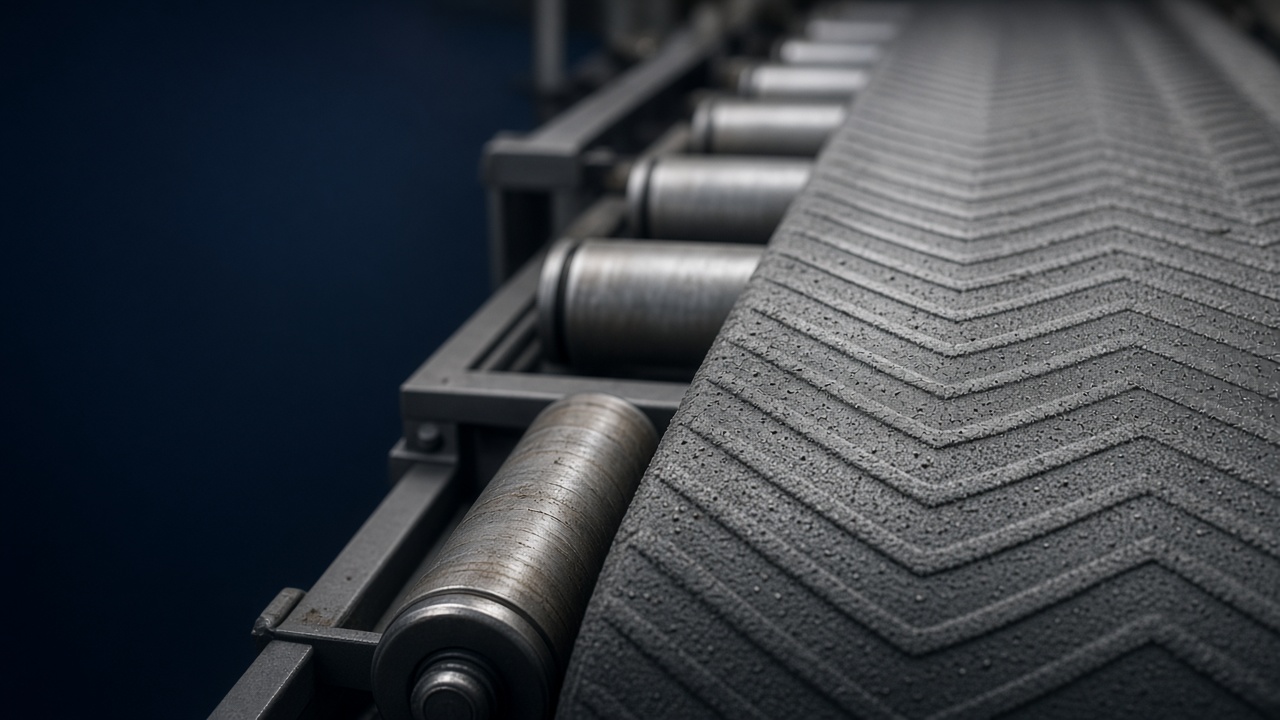
Skirt rubber seals the gap between the loading chute or skirt boards and the moving belt so fines and dust stay on the belt instead of escaping into the transfer house. It is a loading-point sealing product: strips or blocks, often with woven insertion, held in adjustable clamps so crews can lower the seal as it wears. It is not chute lining, pulley lagging or impact sheeting. Those sit under Conveyor Rubber Products. If the chute dumps off-centre, no hardness of skirt rubber will replace geometry.
Part of the Conveyor Knowledge Centre. Research the duty first, then request a quote when you are ready to brief suppliers.
Effective skirting works with correct chute loading, belt troughing and enough freeboard. The rubber rides lightly on the cover; over-tightening cooks the belt and raises power draw. Hardness and edge design are a trade-off between sealing and cover wear. Dual-seal arrangements add a secondary dust lip on particularly dusty coal or concentrate.
Hardware matters as much as the strip. Seized clamps, bent skirt boards and missing holders mean the next length of rubber cannot be set. Segmented blocks allow partial replacement where one hot spot in the chute mouth wears faster than the rest. Continuous strip is simpler for long, even wear. Cassette-style systems exist; name the system if you must stay compatible with existing holders.
South African plants handling wet coal, crushed ore or concentrate rely on maintained skirts for housekeeping and dust control. Wash plants and coastal terminals add corrosion on clamp steel. This page is only the sealing duty at the load zone — not a family catalogue of lagging and liners.
Common applications
Skirt rubber is a scheduled consumable at loading points, not a one-time capital item. Typical jobs include:
- Primary loading-zone seals — Contain product as it settles on the belt after the chute mouth. Length should match the settling zone, not only the steel that happens to still have clamps.
- Secondary dust seals — A second lip for dusty products. Specify that you want dual seal so quotes are not a single strip priced as a complete dust solution.
- Clamp and holder replacement — Restore adjustability when old steel is seized or bent. Rubber-only quotes fail when the holder cannot move.
- Loading-point kits — Rubber, clamps and skirt-board upgrades together — still sealing, still distinct from lining the chute interior with wear rubber.
Industries that use this equipment
Coal handling plants, ore processing and aggregate wash plants are constant users because wet fines escape at the load zone and bury structure.
Cement raw mills and concentrate plants care about dust at intake conveyors; sealing quality shows up in housekeeping labour and in cleaner performance further down the belt.
Ports fight wind-blown fines at transfer towers; clamps and fasteners must survive outdoor moisture.
Underground transfers need compact clamps that crews can service in limited space without a full chute rebuild.
Specifications buyers should consider
The list below is a briefing checklist, not a datasheet. Exact ratings, dimensions and standards must come from the duty, existing plant records and the supplier quotation — do not treat generic web copy as a specification.
- Belt width, trough angle and skirt length along the conveyor — not only “a roll of skirting”.
- Continuous strip, segmented blocks, or a named cassette/holder system already on the plant.
- Rubber only versus holders, clamps and skirt-board steel in the same scope.
- Material handled and whether it is wet, sticky or oily — that changes compound and swelling risk.
- Whether a secondary dust seal is required.
- Belt cover condition: already grooved skirts will not sit on a destroyed cover.
- Idler support in the loading zone: missing impact idlers make the belt bounce so the seal cannot work.
- Corrosion environment for clamp steel: wash plant, coastal, underground.
Factors that affect selection
- Light contact and weekly adjustment usually beat an exotic compound left clamped hard for months.
- Segmented designs waste less rubber when wear is local; strip is simpler for even wear along a long mouth.
- If the belt flutters, fix impact support first — new rubber cannot seal a bouncing belt.
- Do not specify chute-liner hardness for a skirt lip; the skirt has to touch a moving cover.
- Holder compatibility is more important than swapping brand of rubber if clamps are already installed.
- Coordinate with chute work when loading is off-centre; sealing a bad trajectory just wears one side.
Common problems and failure considerations
- Escaped fines burying stringers and seizing return idlers, then blamed on cleaners downstream.
- Over-tight skirts grooving the belt cover and increasing motor load.
- Seized clamps so worn rubber is never lowered, and dust control is lost while “new rubber” sits in stores.
- Ordering general wear sheet from the rubber-products family and cutting it as a skirt — wrong edge and hardness.
- Ignoring missing loading-zone idlers, so the belt sags and the seal opens under surge.
- Mismatched trough angle so the rubber does not follow the belt profile.
Maintenance considerations
- Inspect weekly for light contact, even wear and dust trails at the chute mouth.
- Train crews to lower, not crank: cooking the cover is a setting error.
- Free seized clamps or replace holders during the same stop as the rubber.
- Replace only worn segments if the system allows it; keep spare blocks in stores on remote sites.
- Walk the loading zone for missing or seized impact idlers before ordering another hardness of rubber.
- After chute liner changes, re-set skirts — bolt patterns and mouth width often shift.
Questions buyers should ask suppliers
- Is the quote rubber only, or holders and clamps as well?
- What compound and edge design do you propose so we seal without grooving the cover?
- Can you match our existing holder system, or is this a full clamp replacement?
- Segmented blocks or continuous strip for our wear pattern?
- What belt width and trough angle have you assumed?
- Are stainless or coated fasteners included for wet plants?
- Will you inspect the loading-zone support, or is supply-only the scope?
What to include when requesting a quote
Clear briefs produce comparable quotations. Include what you know, and mark estimates separately from measured values. Photos and drawings help more than extra adjectives.
- Belt width, trough angle, skirt length, photos of current seals and clamps.
- Rubber only versus hardware kit.
- Material, wet/dry, dusty versus coarse.
- Dual seal or single lip.
- Existing holder brand or a measured clamp sketch if unknown.
- Note if impact idlers or chute work will happen in the same outage.
- Site and access — scaffold versus ground-level loading points.
- Do not mix this request with lagging sheet unless you truly want both, listed separately.
Related conveyor information
Related components: rubber products, chutes, cleaners, belting.
Guides: Industrial Conveyor Maintenance Guide.
Resources: Conveyor maintenance guide, How to request a conveyor quote.
Frequently asked questions
How is skirt rubber different from conveyor rubber products?
Skirt rubber is the sealing strip at the loading point. Conveyor rubber products is the wider family: lagging sheets, chute liners, impact pads and wear flaps. A liner compound that survives ore in a chute is often too hard or wrongly edged to run on a belt cover. Brief sealing jobs here; brief liners and lagging on the rubber-products page.
Can I fix dust only by ordering thicker skirt rubber?
Sometimes, if the holders still adjust and loading is central. Often the chute trajectory, missing impact idlers or seized clamps are the real leak. Include photos of the mouth and say whether the belt bounces. Tick Chutes or Idlers on the same request if those assemblies are part of the problem.
Do I need new clamps or only rubber?
If clamps are seized, bent or missing, rubber-only will not restore a seal. State “rubber only” or “holders and rubber” so suppliers do not quote strip against a kit, or the reverse.
Will tight skirting stop carryback at the head pulley?
No. Skirts contain the load zone. Carryback at discharge is a cleaner and scraper problem, plus chute design at the head. Over-tight skirts mainly damage the cover. Use Belt Cleaners and Conveyor Scrapers for return-side and head cleaning, and this page for loading-point sealing.