
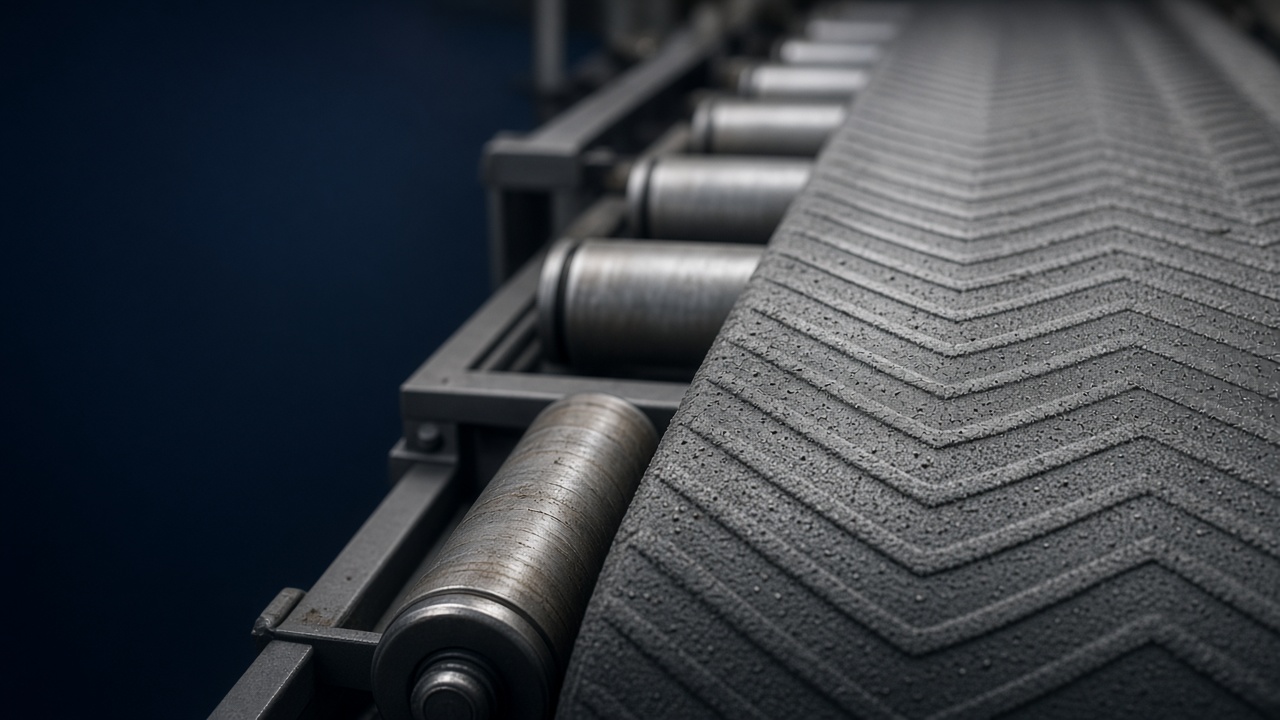
Conveyor belting is the continuous flexible band that carries bulk solids or unit loads along a conveyor. On South African mines and plants the belt is usually a rubber-covered fabric or steel-cord carcass, and life depends as much on chute geometry, cleaners and splicing as on the carcass itself.
Part of the Conveyor Knowledge Centre. Research the duty first, then request a quote when you are ready to brief suppliers.
In local industry, belting almost always means a rubber-covered fabric or steel-cord carcass sized for tonnage, lift, length and material duty. Cover compounds are chosen to resist abrasion, oil, heat or flame depending on the application. Carcass strength is discussed in kN/m on the belt designation — that figure is a tension concept for drive and take-up design, not a number to guess from a web page. Ply count on fabric belts and cord construction on steel-cord belts set how that tension is carried, and they must match the pulley diameters and splice method you intend to use.
Common local grades include general-purpose abrasion-resistant covers for ore and aggregate, heat-resistant belts on sinter or clinker lines, oil-resistant covers around coal preparation or packaging oils, and underground fire-resistant antistatic constructions where mining regulations apply. Sidewall, cleated and pipe belts appear where steeper inclines or dust containment matter. Buyers should separate belt-only supply from splice labour, rollers and structure — many quotations fail when those scopes are mixed without clarity.
Poor chute geometry and missing cleaners destroy belts faster than an under-specified carcass. Edge wear, gouging at the load point and carryback on the return run are usually loading and housekeeping problems first. When a replacement is planned, note width, cover thickness top and bottom, carcass type, length on the roll or on the conveyor, and splice method — hot vulcanised, cold chemical or mechanical — together with any shutdown window for installation.
Common applications
Belting is specified for new conveyors, full replacements after cover wear or carcass damage, and partial replacements where a section has been cut out after a rip or burn. Plants also order spare rolls so a vulcanising crew can restore a critical path at short notice.
- Primary and secondary crushing circuits — Abrasive ore, high impact at loading points and frequent cover wear. Overland conveyors on mines often need steel cord for high tension; short plant feeders may run multi-ply fabric belts with thicker covers at impact zones.
- Stockyard and reclaim systems — Long centres, outdoor UV and weather exposure, and tripper or stacker duty. Spare rolls and planned splice windows matter as much as the cover grade.
- Process and packaging lines — Cleaner environments than the pit, sometimes with food-grade or oil-resistant compounds. Separate these duties from mine-grade abrasion belts when requesting quotes.
- Incline and reclaim belts — Cleats or sidewalls to control rollback of coarse product, or pipe-belt constructions where containment and steep lifts coincide.
Industries that use this equipment
Mining and mineral processing dominate belting demand across the Witwatersrand, Northern Cape, Limpopo and Mpumalanga coalfields. Quarries and aggregate plants run shorter, highly abrasive belts. Cement, fertiliser, sugar, grain handling and ports use belting for raw meal, product and ship-loading. Warehouses and distribution centres more often use lighter package belts or modular plastic, but plant bagging halls still rely on rubber belts feeding palletisers.
Underground coal and hard-rock operations add fire performance and antistatic requirements. Coastal plants may need compounds that tolerate salt air and moisture at transfer houses. Matching supplier experience to your industry shortens technical clarification and improves lead-time estimates for imported carcasses versus local stock widths. Belt failures stop the line: on a mine or cement plant that can idle crushers, mills and dispatch in a single shift.
Specifications buyers should consider
The list below is a briefing checklist, not a datasheet. Exact ratings, dimensions and standards must come from the duty, existing plant records and the supplier quotation — do not treat generic web copy as a specification.
- Carcass type — multi-ply fabric or steel cord — treated as a tension system (kN/m on the designation) that must suit drive pull, take-up travel and pulley diameters, not as a guessed rating.
- Cover compound family: general abrasion, oil-resistant, heat-resistant, or fire-resistant antistatic where underground or process rules apply.
- Cover thickness top and bottom as a briefing item from the existing belt or the duty at impact, not a millimetre figure copied from another plant.
- Belt width matching existing pulleys, idler frames and chute mouths so a replacement does not force a structural rebuild.
- Splice method: hot vulcanised, cold chemical bond, or mechanical fasteners, including whether installation must happen during a fixed outage.
- Special constructions — sidewall, cleated or pipe belt — where incline, rollback or dust containment drive the choice.
- Length on the roll versus length on the conveyor, with allowance for splice preparation and any planned spare.
- Duty description: material handled, lump versus fines, moisture, oil or heat exposure, and whether the belt runs outdoors, in a gallery or underground.
Factors that affect selection
- Impact and abrasion at loading points often govern cover life more than calculated carcass tension.
- Incline, rollback risk and dust containment decide whether a flat troughed belt is enough or whether cleats, sidewalls or pipe belt are justified.
- Existing pulley diameters and take-up travel limit how thick or stiff a replacement carcass can be.
- Splicing access, weather protection and permit-to-work windows on South African mines affect whether hot vulcanising is practical.
- Lead time for imported carcasses versus locally stocked widths can decide whether a temporary mechanical joint is needed.
- Cleaner tip materials and skirt contact must be compatible with the cover compound so the belt is not sacrificed to housekeeping equipment.
Common problems and failure considerations
- Chute mouths that load off-centre or dump from excessive height gouge covers and drive edge damage that looks like a tracking fault.
- Missing or poorly tensioned cleaners leave carryback that seizes return idlers and cooks the bottom cover.
- Mechanical fasteners on high-tension belts can limit cleaner blade choice and become a chronic leak path if used as a permanent joint.
- Mismatched cover grades between two quotes make price comparison meaningless — abrasion versus oil-resistant belts are not equivalent.
- Splices done in rain, dust or with an undersized press fail earlier than the parent belt and force emergency call-outs.
- Storing rolls in sun or standing water ages covers and carcass before the belt ever runs.
Maintenance considerations
- Walk the load point and return run for gouging, edge wear and carryback before blaming carcass rating.
- Keep cleaner tips and skirt rubber in a planned programme; they protect the belt investment.
- Inspect splices for edge lift, blisters and fastener pull-out on a schedule that fits running hours, not only after a trip.
- Photograph damage and chute geometry so vulcanising and belt suppliers see the same evidence.
- Hold a spare length or agreed emergency carcass for critical paths where a ripped belt would idle the plant.
- Plan hot work, power for presses and weather cover into shutdowns rather than treating splicing as an afterthought.
Questions buyers should ask suppliers
- Is this quote for belt only, or does it include splice kits, vulcanising labour and installation?
- Which cover compound and carcass construction are you offering, and how does that map to our material and environment?
- Can you splice this construction on our site with the access and outage window we have?
- Are you proposing a stocked width or an imported carcass, and what does that mean for delivery relative to our shutdown?
- How should cleaners and skirts be specified so they do not destroy the cover you are quoting?
- What installation and splice records will we receive if the belt later fails at a joint?
What to include when requesting a quote
Clear briefs produce comparable quotations. Include what you know, and mark estimates separately from measured values. Photos and drawings help more than extra adjectives.
- Belt width and, if known, cover thickness top and bottom.
- Carcass type (fabric or steel cord) and any designation from the existing belt — including kN/m as marked, not guessed.
- Length required on the conveyor and whether a spare roll is needed.
- Splice method preferred and number of joints, plus shutdown window and site access.
- Material handled, moisture, oil or heat, and whether the duty is underground (fire/antistatic rules).
- Photos of loading points, damaged edges and current splices or fasteners.
- Whether installation, vulcanising and cleaners should be quoted with the belt or separately.
- Plant suburb or mine location so travel and imported-versus-stock lead times are realistic.
Related conveyor information
Related components: vulcanising, cleaners, pulleys, idlers, skirt rubber.
Guides: Conveyor Belt Pricing South Africa, Belt Tracking and Splice Basics, Types of Conveyor Systems.
Resources: Conveyor system cost guide, How to request a quote.
Frequently asked questions
When is steel-cord belting justified instead of a fabric carcass?
Steel cord is typically considered where tension, length or lift take a fabric belt beyond a practical ply construction, or where take-up travel and pulley sizes already assume a cord belt. Short plant feeders and many quarry belts still run multi-ply fabric with thicker covers at impact. The decision belongs in the tension calculation with the drive designer — not as a default upgrade.
Why do chute geometry and cleaners matter more than buying a heavier carcass?
Off-centre loading, high drop heights and carryback attack the cover and edges continuously. A stronger carcass will not save a belt that is being gouged at the load point or cooked on seized return idlers. Photos of chutes and cleaner mounts help suppliers recommend cover grade and a cleaning package together.
Should belt supply and vulcanising be requested in the same quote?
Often yes, when a shutdown must deliver an endless belt. Split scopes are workable if battery limits are explicit: who supplies the roll, who splices, who tensions and who restarts. Mixed quotes that hide splice labour inside a rand-per-metre figure are hard to compare.
How do we compare two belting quotations fairly?
Put both offers on the same width, cover family, carcass construction and splice method. State duty hours, material size and moisture, and whether on-site splicing is included. Two prices on different grades are not equivalent, even if both are labelled abrasion-resistant.